
Section 4 of Mechanical Behaviors and Properties of Gaskets: Tensile Strength and Blow-out Resistance.
To scientifically evaluate the blow-out resistance of a gasket, it is necessary to derive the core relationship from the perspective of mechanical equilibrium to ensure that the gasket can withstand the radial pressure of the medium.
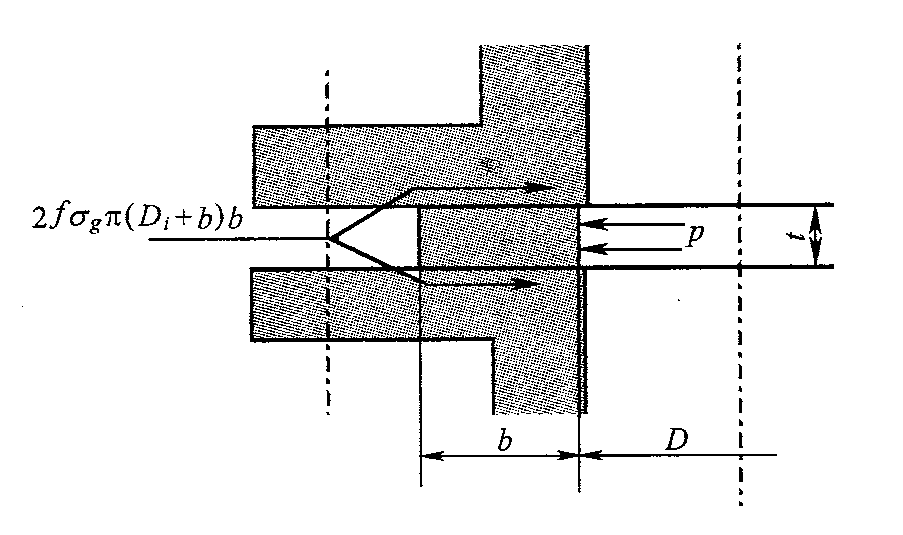
A clear mechanical equilibrium formula can be obtained from the relevant diagrams:
Twice the friction coefficient (f) × gasket stress (σg) × the force-bearing area of the gasket must be greater than the medium pressure (p) × the force-bearing area formed by the sealing thickness (t) and the sealing circumference.
Several key parameters are involved here: Di refers to the inner diameter of the gasket, b refers to the gasket width, t refers to the gasket thickness, σg refers to the gasket stress, p refers to the pressure of the sealing medium, and f refers to the friction coefficient between the gasket and the flange sealing surface (the typical industry range is 0.05 to 0.5).
In practical engineering applications, if the inner diameter Di of the gasket is much larger than the width b and a friction coefficient f of 0.1 is adopted, a more user-friendly calculation formula can be simplified. To prevent gasket blow-out, the working stress of the gasket must be greater than the medium pressure p multiplied by the gasket thickness divided by 0.2 times the gasket width b.
Similar to tensile strength, there is a clear standard test method for the blow-out resistance of gaskets. Through a standardized test process, the blow-out resistance of different gaskets can be accurately evaluated, providing reliable data support for engineering selection and ensuring the stable operation of the sealing system.
For sealing leakage issues, Baohua provides solutions. If you have any doubts about sealing technology, please pay attention to Suzhou Baohua and feel free to consult, comment, or leave a message! Thank you all!See you in the next issue!


 Email:marketing@mybmc.com.cn